
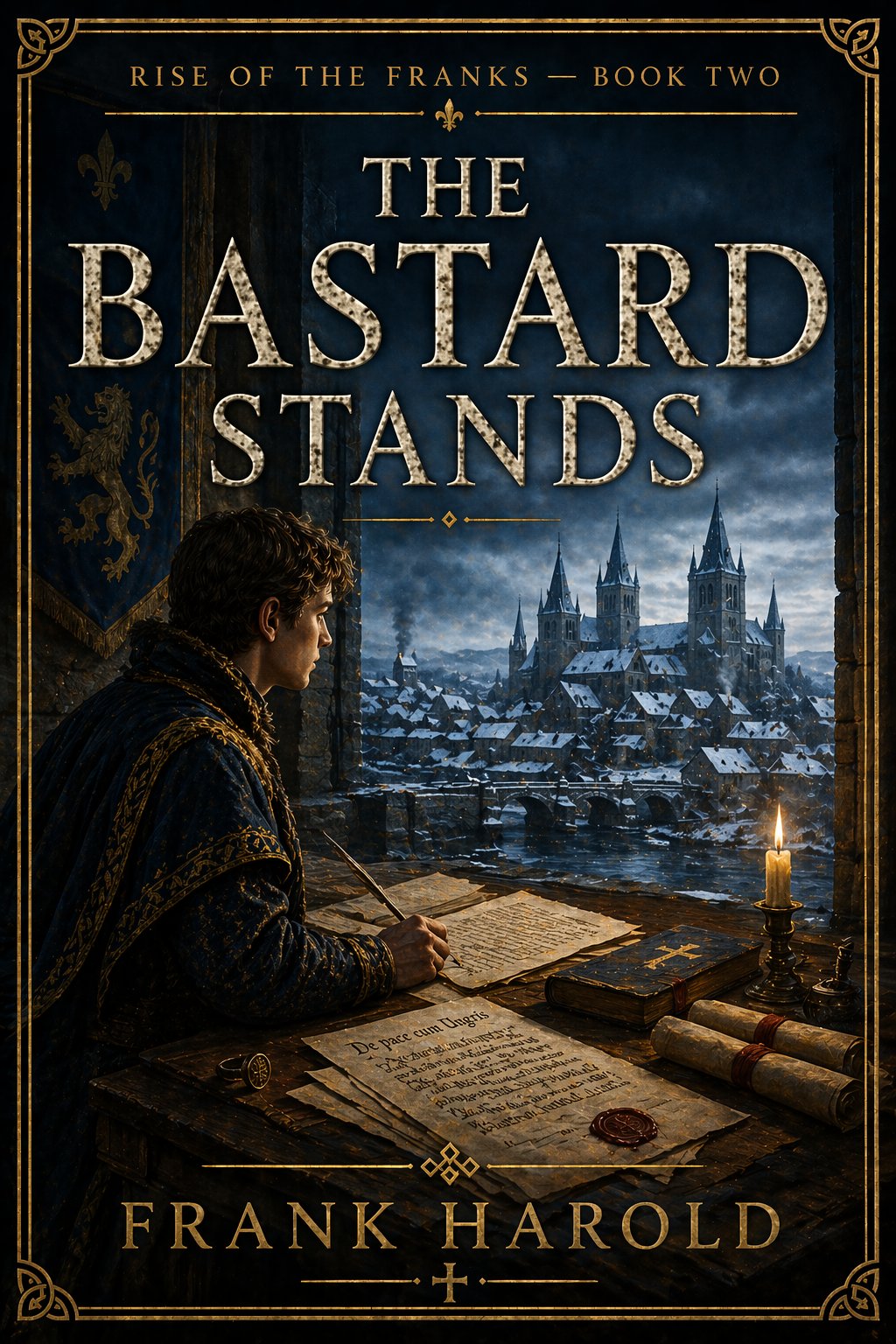
A taste of the opening
Read the first pages
The opening of the book — roughly 3,310 words — to let the voice do its own argument.
Part I — The Peace Held
CHAPTER ONE
The Peace Holds
Metz — The feast of the Epiphany, A.D. 901
The first sentence of the letter had been written three times and crossed out twice, and Hugh of the Saargau, margrave of the eastern Moselle, was sitting at the long oak writing-table in the solar of the Count’s house at Metz in the cold first hour after sext, with the third version of the first sentence still damp on the parchment, when Fulk came in with the second box of the morning’s correspondence and set it on the far end of the table without a word.
Hugh did not look up.
He read what he had written:
The peace holds.
Three words. He had wanted eleven and then seven and then five and had come down, at the third writing, to three. The three were right. He laid the quill in the pewter rest, pressed a palm flat against the parchment so that he would not be tempted to cross through it and try again, and sat a moment looking at the three words as though they belonged to some other hand.
“My lord,” said Fulk.
“Fulk.”
“The second box.”
“Set it down.”
“I have set it down.”
“Then go to your own work and let me finish the first line of this letter. I have been an hour on it and I intend to be another quarter if I must.”
Fulk, who at thirty-seven had been chancellor of the Saargau for seven months and had learned, in that span, a great deal about the moods of a sixteen-year-old margrave writing his first formal report of the treaty year, inclined his head and went back to his own table by the window. He did not sit. He stood at the table and began to slit the seals of the new box with the flat-bladed paper-knife that had been a Christmas gift from the queen, and he did not look at Hugh.
The solar was warm. Metz had been cold since St. Stephen’s, an ordinary January cold with ice on the river and two of the three town wells frozen at the rim, but in the solar a fire had been laid at dawn in the small hearth at the west wall, and the fire had been kept up by the page Berchtold at one-hour intervals, and the room at sext was — for the first time in the morning — comfortable. The wall-hangings had been brought down out of the Count’s chest at the turn of the year; they were old, older than Hugh by seventy years, and they showed, in a faded red wool, the journey of the three magi. The hangings were a gift from the queen. They had arrived with the lancets at Advent. Ota had sent word that the solar at Metz ought to have, in her phrase, something warm to look at in the new year.
Hugh had looked at them, in his first week in them, and had noticed — without saying so aloud — that the middle magus had a face that resembled, if one squinted, the Horka Álmos as he had sat on the stool in the upper room of the Mettlach house at Aachen. He had not mentioned the resemblance to anyone. He was not sure Ota had intended it. He was not sure Ota had not.
He picked up the quill.
He read the three words again.
He wrote, slowly:
Your majesty. I am honored to send, by this courier, my first report of the new year on the state of the eastern frontier.
He set the quill down. He looked at the second sentence. It was correct. It was not — quite — what he meant. He had meant to say: the peace holds, and I do not trust it, but I do not yet have reason not to trust it, and so I will tell you, in the plainest terms, what I see. He had meant, at any rate, something of that shape. One did not write letters to a king in that shape. One wrote a correct sentence first and put the doubt in the third paragraph, where a king could find it if he wanted to find it and could pass over it if he did not.
Theotmar had taught him that at the second council. The rule was: sicut textus Hugonis, in the manner of Hugh’s text — the generous clause last, the difficult clause buried. The rule had been named for him in August. He was now, in January, writing by the rule that bore his name.
He thought, for a moment, that the situation would have amused Fulk, if he had said it aloud. He did not say it aloud.
He wrote the third sentence.
The peace with the Magyars, concluded at Csongrád on the feast of St. Catherine last, has held through the winter. No column of horse has crossed the Enns since the signing. The fortified posts at Passau and at Krems are complete and garrisoned. The third post, at Ennsburg, is under construction; the builder, a man of Regensburg named Wolfram, reports it will be finished by the feast of the Ascension.
He paused.
He read the paragraph.
It was, so far, exactly the letter a margrave was supposed to send a king in January of the first year of a treaty. It was correct, it was brief, it was concrete in its numbers, it did not overstate, it did not understate. It would be read in Aachen, in the king’s private chamber, by the king and the chancellor, and it would be entered in the chancery registers, and it would be — in the judgment of Conrad the seneschal, who had taught Hugh how to write such letters in November — a letter of which any margrave of thirty might be proud.
Hugh was sixteen.
He would be seventeen in December.
He did not, on the whole, feel sixteen. He had not felt sixteen since Remich.
He wrote, as the fourth sentence, the sentence that was the point of the letter:
Your majesty will, however, wish to know of one matter from the upper Enns valley, reported to me by my chancellor in the last fortnight, which I do not consider yet to be a matter of substance but which I note here in order that the chancery’s records may be complete.
He set the quill down and rubbed his right palm slowly along the line of his jaw.
Fulk, at the far table, had finished slitting the seals of the second box and was sorting the letters into three piles — the high pile for court and crown correspondence, the middle pile for margravial-level correspondence, and the low pile for petitions and small administrative matters. He had not spoken in ten minutes. He was, Hugh knew, reading the letters while he sorted them, as was the chancellor’s privilege.
“Fulk.”
“My lord.”
“The freeholder in the upper Enns. His name again.”
“Wendilgard, my lord. A freeholder of about three hundred hides, seated at Greinburg on the north bank. Not a large holding. Not a small one.”
“The second complaint was lodged when.”
“The second collection was refused on the tenth of December. The second complaint came in to me on the nineteenth. I set it aside over the Christmas season. I brought it to you on the Friday.”
“And the neighbor.”
“The neighbor is a man called Richolf, somewhat smaller holding, forty miles east along the same bank. He refused the November collection. He has not, so far, refused a second. But he is in correspondence with Wendilgard; I have a letter from the Regensburg collector that names the correspondence.”
“The ground of the refusal.”
“Wendilgard’s ground, my lord, is that the marcher-fund ought to be collected only within fifteen miles of the frontier line of the Enns itself, and that his holding is thirty miles from the river, and that he is therefore, in his phrase, a man of Bavaria proper and not a man of the march.”
“Is he wrong?”
Fulk considered it a moment.
“My lord, in the letter of the council’s approval he is wrong. The language of the approval is east of the Rhine. It is not within fifteen miles of the Enns. Wendilgard is east of the Rhine. He owes the penny-per-hide.”
“Is he wrong in the spirit of it.”
Fulk said, carefully: “My lord. That is a different question. The spirit of the marcher-fund was that it would fall on the lands most protected by the posts — that is, on the lands within a day’s march of the Enns. Wendilgard is a long day and a half from the river. A Bavarian ox-cart could not, in a short winter day, reach the Enns from Greinburg. In that sense, not the letter, the spirit, he has a case.”
“How much of his levy, in silver.”
“Three pounds and two ounces, my lord. It is not a sum to ride a column for.”
“It is not.”
Hugh picked up the quill.
He read what he had written for the fourth sentence.
He crossed nothing out. He added:
The matter concerns a refusal of the marcher-fund levy by a Bavarian freeholder of the upper Enns valley, one Wendilgard of Greinburg, in the amount of three pounds and two ounces of silver. The refusal is the first of its kind since the fund was instituted. A second freeholder of the same region, Richolf, has refused one previous collection, without stating a ground. I have instructed the Regensburg collector to make one further attempt under the present terms. If the second attempt is refused I will consider the matter further and will return to your majesty with a recommendation.
He set the quill down.
He read the paragraph.
“Fulk.”
“My lord.”
“Come read this.”
Fulk came. He read the paragraph in the slow, careful way of a chancellor who knew that the reading of a margrave’s letter by a chancellor was itself a kind of oath. He read it twice. He set it down.
“My lord. It is a good paragraph.”
“Is it.”
“It is exact. It does not raise the matter higher than it is. It commits the crown to nothing. It reserves your own hand for the recommendation. Conrad would approve it.”
“Fulk. I am not asking whether Conrad would approve it. I am asking whether it is the truth.”
Fulk looked at him a moment.
“My lord,” he said slowly, “I think the truth is that you have a bad feeling about Wendilgard of Greinburg and that the bad feeling is not, yet, in anything you could set down on parchment. The paragraph is the truth of what is on the parchment. The bad feeling is not yet on the parchment. I think you are correct not to put it there.”
“You think it is a bad feeling.”
“I think it is a careful one, my lord.”
Hugh said nothing for a moment.
Then he said: “Three pounds and two ounces is not a sum to ride a column for. It is a sum to lose a year of treaty for. If a second freeholder joins him in the spring, and a third in the summer, by harvest I have a hundred pounds of refusals, and by the autumn following I have a fund that does not collect, and by the winter after that I have posts that do not garrison. This is how the thing comes apart, Fulk. Not by the Magyars. By Wendilgard of Greinburg.”
“My lord.”
“Write Wendilgard a letter. In your own hand, not mine. Tell him that the margrave has noted his correspondence with Richolf; that the margrave will not, at this time, press the three pounds and two ounces; and that the margrave will be in the upper Enns valley before the feast of the Ascension and will receive him, personally, at a court of the march, to hear his case.”
“At a court of the march, my lord.”
“Yes.”
Fulk nodded, slowly. “My lord. A court of the march on a three-pound case will — “
“Will signal. Yes. That is the point. If Wendilgard is willing to argue three pounds at a court of the march before the king’s own margrave, he is willing to argue it in a way the chancery can answer. If he is not willing, he pays the three pounds and we hear no more from him. Either answer is better than the present silence.”
“My lord. I will draft it this afternoon.”
“Good.”
Fulk went back to his table.
Hugh took the quill again. He looked down at the letter. He read, aloud but softly, as he had taught himself to do with formal text before he signed it, the whole first paragraph through the fourth sentence. The reading was clean. He dipped the quill.
He wrote the closing:
I remain your majesty’s faithful servant, Hugh, Margrave of the Eastern Moselle, Count of the Saargau. At Metz. The feast of the Epiphany. The nine hundred and first year of the Incarnation of Our Lord.
He blotted. He folded. He set the letter under the seal-stone while the wax was heating.
Fulk brought the wax.
Hugh pressed the seal — the new seal, cut in the autumn by the silversmith of Metz, the ring of the Saargau bordered by the stag of the eastern Moselle — into the hot red wax, held it a moment, and lifted it clean.
He handed the letter to Fulk.
“The courier.”
“Is waiting, my lord, in the outer court.”
“Give it to him.”
“My lord.”
Fulk went out with the letter.
Hugh sat alone at the writing-table. He looked for a moment at the three magi on the west wall, at the middle one whose face was, if one squinted, the face of Álmos.
He said aloud, to the empty room: “The peace holds.”
He stood.
He went to the window, which looked out over the inner court and the stables and the stone of the Moselle wall. The ice on the river was mottled gray. A pair of crows sat on the gatehouse roof. The courier was mounting in the court below, a tall Saxon with a cloak that had once been good and was now a courier’s cloak, which was to say patched at both elbows and gray with the road.
The courier touched his cap to the page at the gate, took the letter, stowed it in the leather satchel, and kicked the horse into a walk. The horse clattered over the cobbles and out through the Moselle gate and was gone.
Hugh stood at the window until the sound of the hooves had faded.
The peace held.
He did not know, standing there, that by the feast of the Ascension the freeholder of Greinburg would be dead; that by the feast of St. John the freeholder’s cousin would have joined the refusal; that by harvest there would be eleven refusals along the upper Enns valley; that by the feast of St. Martin the son of Árpád would be across the river at the head of four thousand horse; that he himself would be standing, at the feast of St. Thomas of the following year, at the same window in the same solar, with a different letter in his hand, writing that the peace holds still, your majesty, the cost is in the second paragraph.
He did not know any of it.
He only knew that the fire had burned down and wanted stoking, and that there was a second box of correspondence, and that the page Berchtold had come in with fresh charcoal, and that a margrave of sixteen did not stand at the window in January with nothing to do.
He turned from the window.
He went back to the table.
He opened the second box.
* * *
CHAPTER TWO
The Metz Winter
The Saargau — February, A.D. 901
Hugh rode the Saargau in the last fortnight of February, with Roderic and an escort of six, over ground that was half ice and half mud in the low valleys and clean cold stone on the upper roads. The purpose of the ride was administration. It was also — though Hugh had not put it so to Fulk, and Fulk had not said so to Hugh — the margrave’s first sustained appearance in his own county since the progress of the previous autumn, and both of them understood that a margrave who did not show himself in his own villages in the second year of his office became, in a span of months, a margrave whose villages began to decide matters without reference to him.
They set out from Metz on the morning of the twelfth at the third hour after sunrise. Roderic rode on Hugh’s left on the bay gelding he had named Mark, which was a Verdunois joke Hugh had not asked to have explained. Two of the escort rode ahead at a furlong; two behind at the same distance; two with the pack mules in the middle. The weather was cold. The road out of Metz along the north bank of the Moselle was firm; by midday they had crossed the river at the ford below Ars and had turned south into the rolling country of the Saargau proper.
The first night they slept in the hall of the small priory at St. Avold, where the prior Gunzo — a man of fifty-two who had been at St. Avold since he was a novice of twelve — set them at the long trestle and fed them a supper of bean pottage, rye bread, and salt pork. Hugh ate slowly. Gunzo ate across from him and spoke of the tithe-returns for the past year, which were down by perhaps a twelfth from the year before, because the harvest of the previous August had been, in his phrase, a harvest for the account books but not for the granaries, by which he meant the grain had come in by weight but had gone out by weight twice as fast, in the way of a wet year.
“You are concerned.”
“My lord, I am not concerned. Not for St. Avold. We are a small house and we have the lay of the land and we keep enough. I am concerned for the hamlet at Herbitzheim, which is a day’s ride east, and which lost — in the autumn — two of its six oxen to a murrain. I do not know whether the hamlet can plow its north field in April. The margrave’s seneschal will, if the hamlet cannot plow, be without the usual rent on the north field. Three pounds of silver, perhaps. Not a large matter. But the sort of matter your margravial office will, over the course of a year, see a great many of.”
“I will ride to Herbitzheim.”
“My lord — it is out of your road.”
“I will ride it anyway.”
Gunzo looked at him a moment over the candle.
“Yes, my lord.”
They rode to Herbitzheim the following afternoon.
The hamlet was smaller than Hugh had thought. Eighteen houses, a small stone church, a common well, a cluster of goat-pens at the lower end of the lane, and one miller’s place at the top of the hill above the stream. The reeve, a man of perhaps forty called Walho, met them at the lower end of the lane on foot, in his working tunic, with mud on his knees, because he had been — when the escort’s rider had come down the lane — setting a fence-post in the winter ground for a new goat-pen. He did not try to change his clothes. Hugh approved of this, though he did not say so.
End of sample
Continue reading
The full 67,170-word book is available on Amazon as a Kindle ebook.
Available on Amazon →