
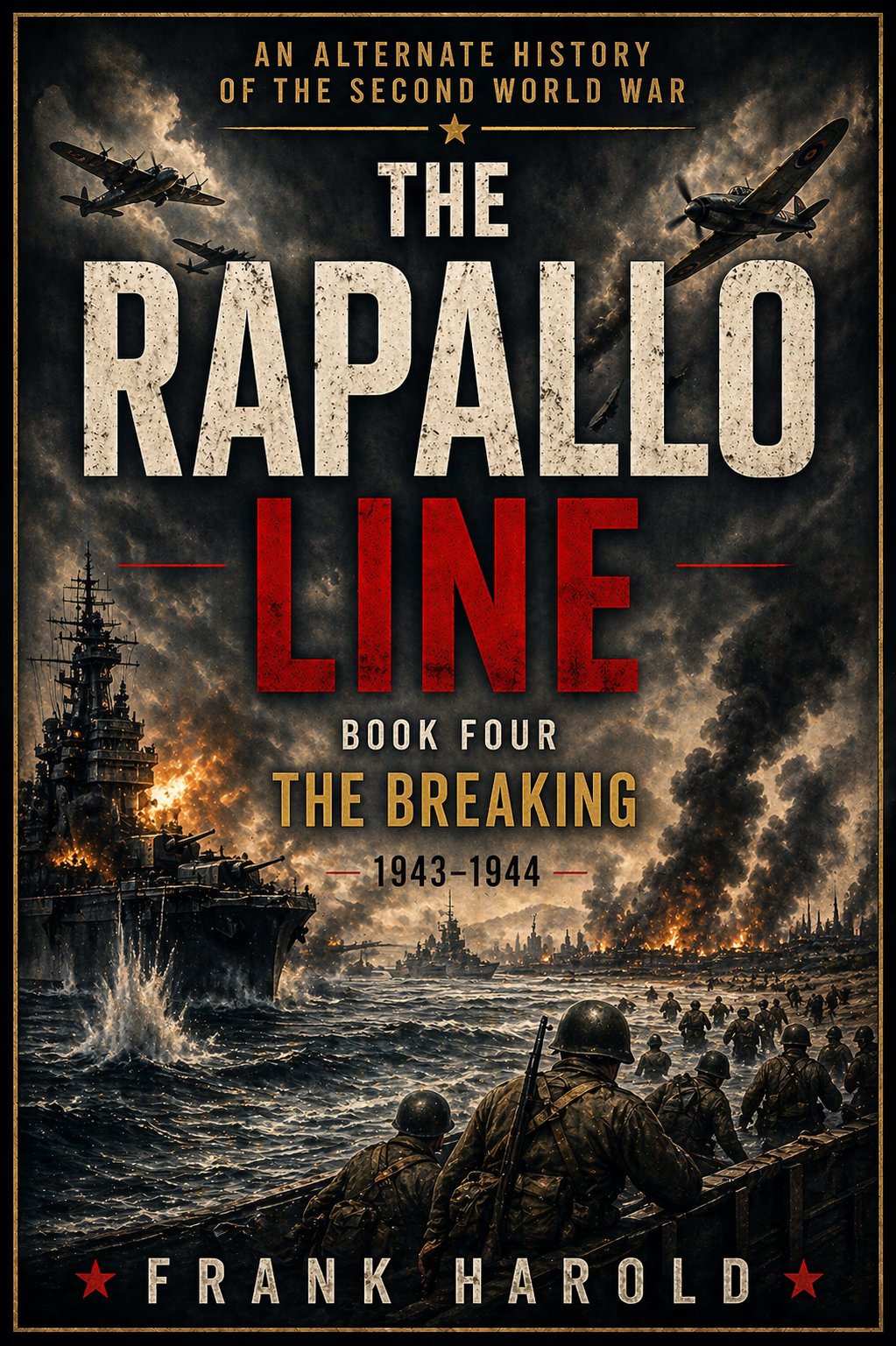
A taste of the opening
Read the first pages
The opening of the book — roughly 3,254 words — to let the voice do its own argument.
AUTHOR’S NOTE
The Rapallo Line is a work of alternate-historical fiction. It imagines a Second World War in which strategic, political, and operational choices diverged from the ones actually made, and follows the consequences through the lives of invented and historical figures alike. Events, dates, and outcomes depart deliberately from the record.
The Holocaust is referenced in this series. Its reality is not altered by the alternate timeline; the murder of Europe’s Jews and other targeted peoples is part of the historical ground on which any honest fiction of that war must stand. The author has tried to depict it with gravity and without exploitation.
Readers interested in the actual history of the period are urged to consult the standard works of scholarship. This series is an argument with that history, not a substitute for it.
A Historical Note
This novel continues the alternate history of the Rapallo Line. The book opens in July 1943. By that date the United States has remained neutral for nearly four years, the Axis holds Egypt, the Soviet Union has entered Persia, and the Rapallo Pact — extended in 1940 to include the Empire of Japan — holds in Europe and is widening in Asia. The central event of this book is the Japanese invasion of the Philippines in early August 1943, which ends the American neutrality and makes the war, for the first time, global. A fuller account of the real history against which the novel is set will be found in the Historical Appendix at the end of this book.
CHAPTER ONE
The Last Quiet Month
Tehran, the British Legation, 9 July 1943
Ashworth had been in Tehran for nine months and had come, in that time, to understand the summer. The summer was not the thing the guidebooks called it. The guidebooks, which had been written in Edwardian weather and in the climate of a world that had not yet discovered what the heat of Persia could do to a European man, called it hot. It was not hot. It was a condition of the air, a hammered brightness, which, between noon and four, removed from the city the possibility of thought. It had been forty-one degrees at one o’clock. It was, at the hour he sat down at his desk, thirty-seven, and going down as the sun went down; in an hour it would be thirty-four and endurable; by midnight, if the wind came up from the mountains, it would be twenty-seven, and a man would sleep.
He sat in shirtsleeves at the desk in the small room at the back of the chancery which Bullard had given him in October and which he had not, in nine months, arranged to his satisfaction. The room had a desk, a chair, a filing cabinet of the War Office pattern, a ceiling fan, and a narrow window which gave onto the south wall of the compound. He had added to it, over the months, a second chair, a kettle, a tin of Fortnum’s tea which his sister had sent by the diplomatic bag in January, and a small framed print of Durham Cathedral which had been in his room at Broadway in 1940 and which had followed him to Cairo and to Tehran and which he did not, now, imagine he would ever unpack and hang in a house of his own.
The signal he was drafting was for Broadway, and it was the signal for the week. He had written the weekly signal forty-one times. He had, in the course of that writing, settled into a prose which was neither his Broadway prose nor the Foreign Office prose of the chancery, but a third prose, shorter and drier than either, which had evolved to contain what he had to say and to contain nothing else. The signal this week concerned the Soviet summer order of battle on the Hamadan front, the morale of the Imperial Iranian Army, the situation of the gendarmerie in the provinces west of Qom, and, at its end, in a single paragraph of three sentences, the matter of Volker.
Volker was the name that had been used, in the Abwehr cables read at Bletchley in the winter, for the asset run by Brandt of the Southern Section out of Tirpitzufer. The cables had gone cold in March. Ashworth had concluded, in April, that the asset had been stood down. He had, in May, received a report from the Persian gendarmerie of a Polish émigré of that name who had opened a tea-merchant’s cover at the north end of the Tehran bazaar. He had, in June, received a second report, noting that the tea-merchant had relocated to a flat in a building off Pahlavi Avenue, and that the flat was visited, on occasion, by a man from the Soviet commercial attaché’s office. He had, the previous evening, received a third report, from a different source, which placed the same man at a function at the Turkish Legation in company with a minor attaché of the Soviet Embassy.
Three reports constituted, in Ashworth’s practice, a pattern. He had underlined, on the third report, the word Volker, and had written, beside it, in the soft pencil he used for the things he was not yet ready to write in ink: *This is not an Abwehr asset.* He had not yet decided what it was.
He wrote, in the signal to Broadway:
1. HAMADAN FRONT. No change in forward positions since report of 02/07. Soviet 47th Army continues to hold the line Qazvin–Saveh with probable intent to maintain pressure through September. Imperial Iranian units to the east of the line are reported demoralised but have not yet disbanded.
2. GENDARMERIE. Reports of disorder in Yazd and Kerman, attributed to food prices rather than to Soviet agitation. Minister advises that the Shah’s ministers are not disposed to act.
3. VOLKER. The subject previously reported, formerly assessed by this station as a dormant Abwehr asset, is now in open and regular contact with officers of the Soviet Embassy. I should be grateful for the Section’s assessment of the possibility that the original Abwehr traffic was a Soviet cover. I intend no immediate action pending the Section’s view.
———
He read the signal twice. He changed, in the third paragraph, one preposition. He folded the flimsy and put it in the out-tray for the cypher clerk. He sat, for a moment, at the desk, and looked at the framed print of Durham Cathedral on the wall, and he thought, as he sometimes thought at this hour, that he was a long way from any cathedral.
Then he put on his jacket, which he had taken off at eleven, and went out to find Bullard, whom he owed, by the unwritten practice of the Legation, a summary of the signal before it left the building.
❖
The Atlantic, the Submarine Tracking Room, 16 July 1943
Third Officer Mary Godfrey, WRNS, came on watch at midnight and found, in the first hour, that the Atlantic had, that night, gone quiet.
She had come to expect, after eight months in the Tracking Room, a certain shape to the watches. The watch began with a take from the direction-finding network, which was always worst in the hours after sunset in the western ocean, and went on with the ingathering, through the early hours, of the first of the contact reports from the convoy commodores, and culminated, in the small hours, in the moment at which the plot, under the competing crosses of fix and contact and estimate, became, for a quarter of an hour together, clear. That was the hour of the decision. It did not always come. When it came, it was what the watch was for.
On this night it came, and it was empty.
She had, on the plot, two convoys at sea in the mid-Atlantic: HX-248, thirty-seven ships, outbound from Halifax to Liverpool, in the eastern leg of its passage, four days from the Western Approaches; and ON-196, forty-one ships, outbound from Liverpool to Halifax, three days from its port. She had, on the plot, two active U-boat concentrations known to the Tracking Room, one in mid-ocean north of the Azores and one south of Iceland. She had, at the beginning of the watch, expected both convoys to make contact with one of the concentrations. By 02:30 she had concluded, from the silence of the direction-finding net and the silence of the convoy commodores alike, that neither was going to. By 03:00 the plot showed the two convoys passing each other at a distance of some three hundred nautical miles, in clear weather, with the U-boat concentrations drifting north and south of their tracks and, for reasons which the plot could not tell her, not closing.
By 04:00 she had, for the first time since she had come to the Tracking Room, a plot on which seventy-eight merchant ships were at sea in mid-ocean and were, so far as any instrument the Admiralty possessed could tell, in no present danger.
She wrote this up, carefully, in the watch log. She wrote, in the column for remarks: *Both convoys proceeding without contact. Air escort from Iceland reports two U-boats sighted and attacked; results not yet assessed. The ocean is, at this hour, quiet.* She underlined, in her careful small hand, the last phrase. She was not certain why.
At 06:30 the watch changed. She handed over to First Officer Bartlett with the standard summary, and Bartlett, who was not a woman given to the admission of astonishment, said, at the end of the summary, “Is that the whole of it.”
“That is the whole of it, ma’am.”
“No sinkings.”
“No sinkings reported during the watch.”
Bartlett looked at the plot. She looked at it the way a woman looks at a view from a hotel window she is not certain she will ever see again.
“Well,” she said. “They come, and they go.”
“Ma’am.”
“Go home, Godfrey.”
She went home. The walk to the flat in Pimlico took, that morning, twenty-eight minutes, and she timed it, as she had fallen into the habit of timing it, on the wristwatch her father had given her at Easter. The streets were cool in the early hour. The sky over the parks was the pale, uncertain blue of a London summer dawn. A milk-float passed her at the corner of Victoria Street. At the flat she let herself in, made tea, and sat at the small table in the kitchen, and drank it, and did not, for some time, do anything else.
She thought, over the tea, that she had plotted, at some hour in the night, a piece of the war which her grandchildren — if she had any, which, at twenty-three, she did not presume — would ask her about, and which she would not know how to describe, because the thing that had happened was a thing that had not happened. The ocean had been quiet. The ships had gone through. That was what had happened.
She finished the tea. She went to bed. She slept, in the July light, with the curtains drawn, until a quarter past two in the afternoon, and when she woke she lay for a long time in the bed without getting up.
❖
Imperial General Headquarters, Tokyo. 18 July 1943, 10:00
The Imperial General Headquarters convened at ten on the morning of the eighteenth of July in the Army-Navy Liaison Conference Room on the second floor of the Sanbō Honbu at Ichigaya. Present on the Army side: General Sugiyama Hajime, Chief of the Army General Staff; General Tōjō Hideki, in his dual capacity as Prime Minister and Army Minister; Lieutenant-General Muto Akira, representing the Army Operations Section; General Yamashita Tomoyuki, designated commander of the Fourteenth Army for the Philippine operation, flown in from his headquarters at Formosa; and Colonel Hattori, Army Operations. On the Navy side: Admiral Nagano Osami, Chief of the Navy General Staff; Admiral Shimada Shigetarō, Navy Minister; Admiral Yamamoto Isoroku, Commander-in-Chief of the Combined Fleet, flown up from Truk the previous evening; Vice Admiral Itō Seiichi, Vice Chief of the Navy General Staff; and Rear Admiral Kuroshima, Yamamoto’s chief of staff. The Emperor was not present. A representative of the Court was in the room at the request of the Lord Keeper of the Privy Seal, and sat behind Nagano, and did not speak.
The agenda was Operation Kyushu-Gō, the invasion of the Philippine Islands, scheduled for execution on the fourth of August.
Nagano opened. He was the senior naval officer in the empire, sixty-three, and had conducted the conferences in which the decision for war had been, in 1941, postponed and, finally, not taken. He had, since, conducted a great many conferences on what the empire should do in the condition of non-war with the United States that had, through 1942 and into 1943, prevailed.
“Comrades. The Combined Fleet and the Fourteenth Army report that Kyushu-Gō is ready for execution on the fourth of August. The operation, as approved at the Imperial Conference of the fourteenth, will open with a carrier strike on the American naval forces at Manila and Cavite at oh-four-twenty on the fourth. It will continue with landings by the Sixteenth and Forty-Eighth Divisions of the Fourteenth Army at Lingayen Gulf in the afternoon of the fourth and at Lamon Bay on the fifth. The Commonwealth and American forces on Luzon are to be reduced within sixty days. The American strategic position in the western Pacific is to be eliminated.”
“Admiral Yamamoto. Is the Combined Fleet ready.”
Yamamoto stood. He was, at fifty-nine, three inches shorter than Nagano, with the compact, quiet carriage of a man whose career had been fought in wardrooms as much as in ships.
“The Combined Fleet is ready. The First Air Fleet, under Nagumo, has three hundred and eighty-four aircraft on six carriers at Truk. The Second Fleet, under Kondo, will deliver the landing force to Lingayen and provide the surface action against any American naval response. The Ninth Fleet has been activated under Ozawa for Philippine area support. The fleet is ready. I am obliged, however, to note to the Conference, as I have noted to the Navy General Staff on three previous occasions, that my professional assessment of the operation’s strategic consequences remains what it was in February.”
Silence.
Tōjō said: “Admiral. The Imperial Conference has taken the decision.”
“The Imperial Conference has taken the decision. The operation will be executed. I am not, Mr. Prime Minister, reopening the decision. I am recording, for the record of this Conference and not beyond it, that the Combined Fleet will execute an operation the strategic consequence of which is, in my judgment, the entry of the United States into the war against the Empire, at such hour as the American President chooses, in such strength as the American industry can produce, for such duration as the American people can sustain, and with such consequence as the Navy has, since 1921, advised against.”
“Admiral. The Americans have not entered the war in nineteen months of war against Germany, against whom they have every political reason to fight. They will not enter a war in the Pacific, against us, whom they have no reason to fight, over a possession which their own President has, since 1934, stated publicly is to be granted independence in 1946.”
“Mr. Prime Minister. That is the Army’s assessment. It is not the Navy’s.”
“The Navy’s assessment, Admiral, has been, since February, that the Americans will enter the war on any provocation. The provocations we have extended to them in the Pacific since December 1941 have included the occupation of Guam, the occupation of Wake, the occupation of the Philippines’ outlying islands, the attack on British Hong Kong, the attack on British Singapore, the attack on British Ceylon, and the bombardment of the Indian coast. None of these has produced American entry. The occupation of the Philippine main islands, which are the last American possession in the western Pacific, will produce an American response which will be, in my assessment, a protest, an embargo, and an acceleration of the American two-ocean navy program. It will not produce an American declaration of war.”
“Mr. Prime Minister. The occupation of Guam in December 1941 was permitted by the Americans because it was a gesture rather than a strategic act. The Philippines are not a gesture. The Philippines are the base from which the American submarine force has, for nineteen months, interdicted our oil convoys from Sumatra. The Philippines are the base from which the American Asiatic squadron was, until its withdrawal to Pearl Harbor in 1942, deployed. The Philippines contain, at this hour, an American army under General MacArthur of fifty thousand men. We propose, on the fourth of August, to attack that army. When we attack an American army of fifty thousand men, the American President will not, as he has not for nineteen months, be permitted by his own Congress to remain at peace.”
Nagano, the senior admiral, said quietly: “Mr. Prime Minister. The Admiral Yamamoto is, in his particular, correct. The Imperial Conference has, nonetheless, decided. The Navy will execute.”
Sugiyama, the Army Chief of Staff, spoke for the first time. He was a different kind of soldier from Yamashita: heavier, slower, a courtier as much as a field officer.
“Admiral. The Army has, in this Conference, listened to the Navy’s reservations. The Army notes them. The Army believes, on balance, that the moment for the operation is now, for the reason that the American industrial mobilization, if unopposed through 1943, will produce by the summer of 1944 a Pacific naval force that cannot be defeated by any operation of any kind we can mount. Our window is narrow. It is, in the Army’s judgment, this summer.”
Yamamoto said: “The window, Chief of Staff, is narrow for the reason that the United States is larger than the Empire of Japan by a factor of ten in industrial capacity and by a factor of twenty in raw materials. The narrowness of the window is a consequence of the asymmetry. The operation we are about to conduct, in the narrow window, does not correct the asymmetry. It merely compresses the timetable on which the asymmetry will produce its consequences. If the operation succeeds in August, we shall have won a victory in September. We shall have secured the Philippines by November. We shall have consolidated our position in the southern resource area by February. In March of 1944 the United States Navy will commit the new Essex-class carriers. In May of 1944 it will commit the new Iowa-class battleships. In July of 1944 it will commit the second and third increments of Marine divisions. By the end of 1944, we shall have lost the initiative. By the end of 1945, we shall have lost the war.”
Tōjō said, in a tighter voice: “Admiral Yamamoto. The Emperor has approved the operation.”
“I am aware, Mr. Prime Minister, that the Emperor has approved the operation. I am not, as I stated in my opening, reopening the decision. I am, however, a serving admiral of the Imperial Navy, and my service includes, in the hour before an operation of this weight, the obligation to state my professional view once and for the record. I have stated it. I will not state it a second time. The Combined Fleet will sortie on the thirty-first of July and will execute on the fourth of August.”
End of sample
Continue reading
The full 59,784-word book is available on Amazon as a Kindle ebook.
Available on Amazon →