
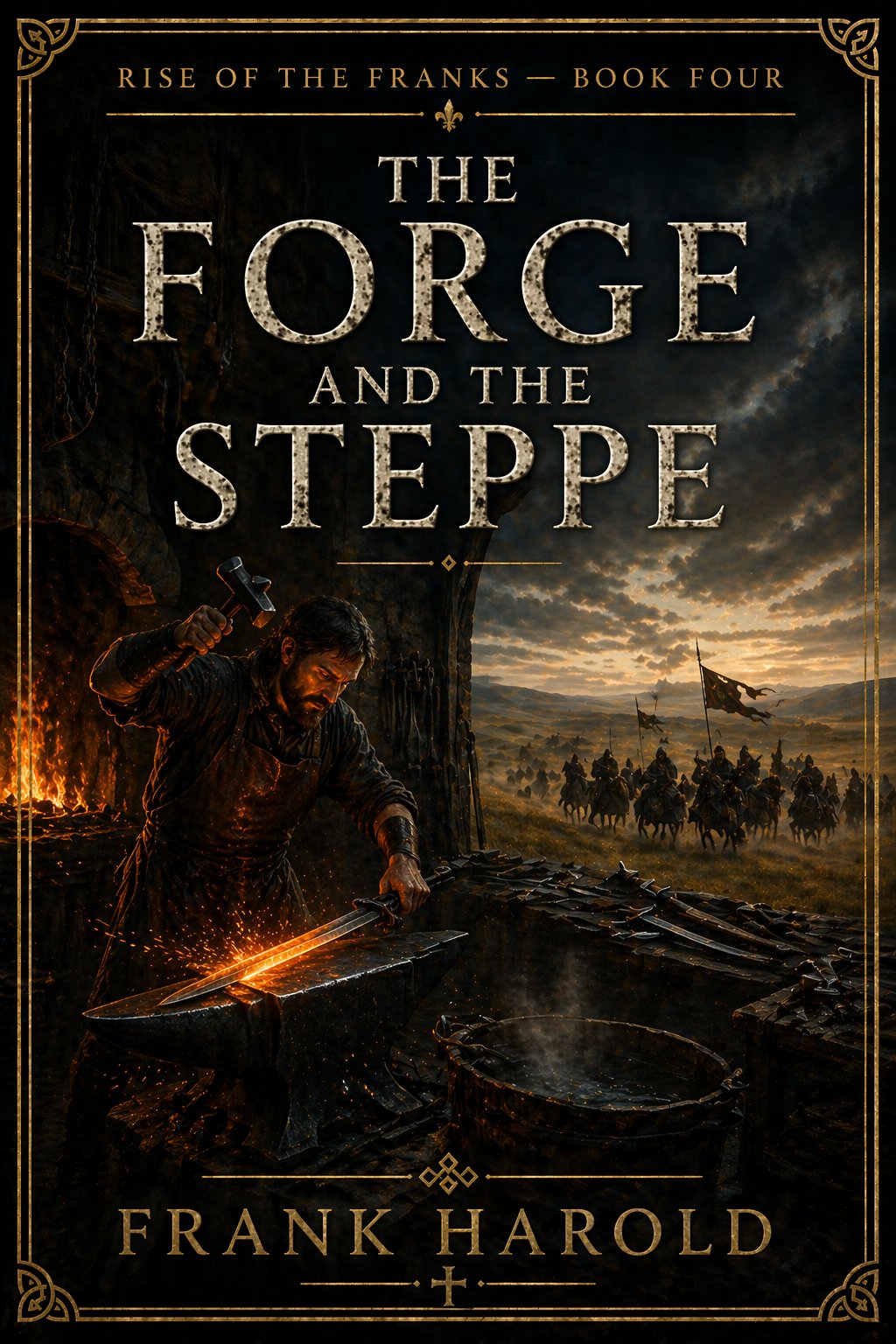
A taste of the opening
Read the first pages
The opening of the book — roughly 3,232 words — to let the voice do its own argument.
Part I — The Forge
CHAPTER ONE
The Feast of Saint Agnes
Metz, the forge compound on the west ward — 21 January 903
The frost lay on the west ward in a thin crust, still hard in the shadow of the compound wall but turning soft where the morning sun had reached it. The air above the anvil went up in a shimmer. Leo stood at the hearth with his hammer held level, his apprentices — one new boy from Mainz, two from the cathedral school at Metz — in a line behind him with the tools laid out on the stone bench. The bishop was at the gate in his winter cloak, his hands tucked under the hem of his overcloak. Fulk stood beside him with the ledger open.
The forge-compound had taken shape over the winter months on the west ward of the duchy house — a low stone building with three bays, the hearths aligned north to south, the anvils set on stone bases, the tool-racks hung at the proper height. The charcoal was stacked in cedar boxes on the eastern wall, kept dry, kept close to hand. The metal work had been hard: the chimney stack alone had required a mason from Verdun to get the draw right, the slope of the flue, the facing of the brick. But the work held now. The fire was good. The heat climbed to what Leo needed it to climb to. The first blade would come clean.
Hugh came through the compound gate at the ninth hour of the morning. Gerberga was at his left hand, her fingers hooked into the crook of his elbow. Behind them came Kurt of Trier, his beard still caked with the dust of yesterday’s ride from the south, a man of forty-eight with the shoulders of a smith who had held a hammer for thirty years without rest.
The blade lay on the anvil. It was not yet a blade — it was a bar of steel no thicker than a man’s thumb and as long as a forearm, glowing red in the hearth-light. Leo looked at Hugh. Hugh did not move. The hammer rose. The frost rang.
The strike came down cleanly. The second strike, the third, the fourth. With each strike the bar shifted under the hammer, and the apprentices worked it with their smaller hammers in the beat between Leo’s great swings. It was work Hugh had seen Leo do a hundred times in the forge at Regensburg — but here, in this new compound that had been built under his writ in the month of November, with a bishop at the gate to bless the hearth, it was a new thing. This was the first blade the duchy would forge under its own roof.
Leo worked the bar. The red began to deepen to orange. The hammer sang. The boy from Mainz flinched on the third strike, not from fear but from cold — his hands were shaking. Leo did not slow. The hammer came down, and came down, and came down.
At the seventh strike the bar had taken shape. It was no longer a bar. The point had drawn out. The edge was beginning to form. Leo eased his pace. The final strike came at the eighth blow, and the hammer lifted, and the work lay red on the anvil.
Leo said nothing. He handed the hammer to the boy from Mainz — who took it with both hands, his face gone pale at the weight of it. The boy’s name was Ulrich. He had come to Metz from Mainz three weeks prior, apprenticed to the cathedral smith and now loaned to Leo for the year. He stood there with the hammer resting on his chest, breathing hard. Leo nodded to him, not in approval or disapproval, but in acknowledgment: the hammer was yours to hold now, even if only for a moment. Even if your hands are shaking.
Kurt stepped forward. He had a small vial of oil at his belt, and a cloth. He took the blade by the tang with tongs, and he dipped it once in the oil, and once again. He set it down on the stone bench. He let it cool for perhaps twenty heartbeats. Then he picked it up with the cloth and bent it in his hands, testing the flex. He bent it again, the opposite way. He did not bend it a third time.
He nodded.
“The temper is right,” he said in the Trier dialect, the vowels flattened in a way that Hugh had not heard in three years of war. “Gut genug. Morgen besser.”
“Good enough. Tomorrow better.”
Leo took the blade from Kurt’s hands and set it on the cooling stone. The bishop came forward. He had a censor at his belt — small, practical, the kind carried to forge-openings and new halls — and he opened it and the smoke rose up in the Moselle wind and curled around the anvil and the boys. He spoke the Latin blessing of iron, of fire, of water, of the smith’s hand. The boys crossed themselves. Kurt crossed himself. Leo did not.
Hugh stood at the gate with Gerberga at his arm. The blade lay on the cooling stone, its surface already dulling from the red to the brown of old blood. In the light of the hearth it still held a sheen.
The bishop finished. He raised his hand. He said, in Latin, to all of them: “May the work done here be strong, and true, and serve the peace of the realm.”
“Amen,” said the apprentices.
“Amen,” said the bishop.
No one else spoke.
Hugh took a step forward. His voice, when he spoke, was as plain as the hammer had been plain.
“This is the first blade of the duchy’s forge. The second will be struck tomorrow. We will strike four thousand in the year. The iron is ours now.”
He said nothing more. He turned, and he took Gerberga’s hand, and they walked back through the compound gate toward the ducal house.
Behind them, the forge emptied slowly. The apprentices moved the cooling blade to the work-table, their shadows long against the compound wall. Kurt stayed at the anvil, his hands gripping the edge of the stone, feeling the heat still rising from it. He had come south from Trier with two apprentices and his cook and the knowledge of forty years in iron. The duke had said four thousand blades in the year. That was not madness. That was war-planning. Or it was peace-planning so deep it looked like war. Either way, Kurt would deliver it. The forge had good bones. The iron was not excellent — not yet — but it was honest work. The apprentices would learn. By midsummer they would have fourteen hands moving the hammer, and by autumn, if the iron held, they would have the tally the duke wanted. He released the anvil’s edge and stepped back. The first blade was done. The second would be tomorrow, and his hands would be steady for it. He walked to the compound gate and looked back once at the cooling steel on the work-table. It sat there in the dying light, brown and ordinary, but it had been struck in the duke’s house, under a bishop’s blessing. It was the first. Tomorrow it would be the second, and the day after, the third. By autumn, four thousand.
Behind them, Kurt was already pointing at the anvil, already speaking to the boy from Mainz about how the hammer-weight would need to shift on the next blade, how the bar would need to be longer, how tomorrow the work would be better.
At the gate, Fulk set down the ledger. He had a small scale in his hands — bronze, precise, the kind that had come from the merchant-quarter at Aachen. Leo brought the blade to him, still warm from the quench. Fulk set it on the scale. He adjusted the weights. His finger moved the beam slowly, carefully, reading the balance. He nodded to Leo.
“Three pounds,” he said. “Eight ounces. It will do.”
He wrote the number into the ledger in his small neat script: III librae. VIII unciae. Prima lamina. Festum Sanctae Agneti. Anno DCCCCIII.
The first blade. The feast of Saint Agnes. The year 903.
* * *
In the evening, at the solar, the shutter sat proud at the top of the east window where it always sat, the gap a finger’s breadth wide, the wind whistling through it in the night. The room was cold. The brazier had been lit, but the stone walls held the winter in them still, and the cold seeped down from the vault above where the rafters were exposed and the old thatch had been replaced with tile in October. Hugh was at the writing-table. Ota’s writ lay on the table — sealed, dated, addressed to him from Aachen. The knife of the Kér was beside it, the blade still marked where it had been used three years before to cut the peace-token, the agreement with Taksony’s father. He held the writ in his hands. The seal was good wax, the impression of the regency stamp clear. Inside would be the confirmation of the Easter council date and the Swabian question and the approval for whatever work he meant to do in the year ahead. He had not opened it yet. He was not ready to open it yet.
Gerberga came through the doorway. She did not come to the table. She came to the window, and she put her hand on the shutter where it sat proud, as if she might push it flat into the frame, but she did not push it.
She said, quietly, “Husband.”
“Yes.”
“I have missed my courses a second time.”
Hugh set down the writ. He stood. He walked to her at the window. He looked at her face, at her eyes, at her mouth. He put his hand on her belly, under her overcloak, under the linen of her dress. There was nothing to feel yet — no weight, no change — but the gesture was the gesture the Bavarian women had taught him, from his time under Liutpold’s roof in the years before he had come to Metz.
He said, “The child.”
“The child,” she said.
He left his hand there. They stood at the window, and the wind whistled through the proud shutter, and in the courtyard below, the first blade of the duchy’s forge lay cooling on the stone, and in the forge compound the apprentices were clearing the hearth for the night, the frost beginning to take hold again on the west ward as the sun fell toward the Moselle. Through the open courtyard gate, Hugh could see the Moselle water running dark. The river never froze entirely, even in deep winter — the current kept the ice from setting. The water turned and turned, and in spring it would turn faster, and the wheel would turn with it. The second wheel would come. The road would come. The column would ride. The child would be born. None of it yet. All of it beginning now.
Hugh stood at the writing-table. Ota’s writ lay before him, and the knife of the Kér, and the blank parchment that Fulk had left for him to draft the Easter council reply. He did not pick up the reed yet.
He said aloud, to the room that had held him since November, to the solar that was not yet familiar, to the table that was not yet his:
“Jetzt. Nicht später. Over a die-block, now.”
The words hung in the cold air. The shutter moved. The candle shifted in the draught.
Gerberga had gone to her chamber. He could hear her footsteps on the stone stair, the soft closing of the inner door. The child. The child would be born in the autumn, if the calculations were right — in the month when the second water-wheel would be running, when the road to Regensburg would be half-laid, when the standing company would ride for the first time in full strength. The year would shape itself around the child as much as around the forges. That was the contract he had made with Ota in the November council: the realm’s work, and the family’s work, running in parallel, inseparable. The blade on the cooling stone in the compound. The child in Gerberga’s belly. The die-block waiting. The penny not yet struck. All of it was now. All of it was not later.
He took up the reed and began to write.
CHAPTER TWO
The First Penny
Metz, the mint east of the cathedral — late January 903
The die-block lay on the anvil. It was a cube of iron the size of a man’s closed fist, heavy enough to take two hands to lift, and the die was cut into its top face — the obverse showing Louis’s name in the old Aachen style, with a small cross below the letters. The reverse die, on the bottom of the block, lay against the anvil itself, cut deep with three lines of text: HVGO DVX, the letters spaced to leave room for a star between the first two lines and the second pair. The block was cold at this hour. The lamps burned at the anvil’s corners, and the warmth of them had not yet reached the iron.
Fulk stood at the anvil with his sleeves rolled up. He was not usually a smith — he was the chancellor of the ducal house, the keeper of charters and writ, the man who held the seal. But he had learned, in the past month, to strike a penny. Eudoxia had shown him the motion. Leo had shown him the force. Kurt had shown him where the weakness lay in his arm — on the side, not direct. He had struck three hundred practice strikes against a stone anvil in the cellar, where the sound would not carry.
This strike was not a practice strike.
Hugh stood at the window of the mint-house. The building was new — built in the first week of December on the stone foundations of an older structure that had stood empty for sixty years. The walls were smooth chalk-stone brought from the north, the roof was slate, and the central room was built with a high ceiling to allow the hammering-smoke to rise and clear. Beside the anvil was a table with the cloth sacks ready, the ones that would hold the pennies as they were struck, marked and counted.
It was still dark. The fourth hour of the morning had not yet come. The feast was over — the feast of Saint Agnes had given them the first blade, the ceremonial moment — but the mint had its own opening, quieter, witnessed only by the people who worked it. Ota’s writ had come back in the first week of January, sealed and official: the Metz mint was authorized to strike the kingdom’s penny under Hugh’s seal and the regent’s authority, the first such mint west of the Main since the years of Charles the Great.
Leo was at a small table to the side, reading from the second codex — the one he had been reading at Regensburg, the one about the older shapes of things, old engines, old ways of working. He was not here to strike the penny. He was here because he had been asked to be. Hugh wanted him to see it.
Fulk raised the die-hammer. It was smaller than Leo’s hammer, lighter, designed for precision rather than force. It had taken him three days to learn not to let it turn in his hand at the moment of the strike. The penny blank lay on the lower die, held by two small tongs that he would have to release at the moment of striking.
He raised the hammer.
He brought it down.
The strike was clean. The hammer lifted. The tongs came away. The blank lay on the lower die, and Fulk set his thumbnail at the edge and lifted it. The penny came free.
He held it up to the lamp.
The face of the coin glowed. The die had pressed into the metal cleanly, the letters sharp, the cross precise. It was the first penny of the new mint. It was the first penny that bore Hugh’s name, and the king’s name above it, and the Metz die-mark that would tell every merchant and every counter from here to the March of Bavaria that this was the coin of a real place, a real duchy, a real power.
Fulk set the penny on the cloth. He looked at Hugh.
“One,” he said.
Hugh came to the anvil. He did not speak. He took the penny in his fingers and held it to the lamp. It was lighter than the Bavarian pennies he had held at Aachen — lighter in the hand, but when he tested it by eye against the measurement they had brought from Verona, it was true. The die-cutter had cut true. The hammer had struck true. The die had not slipped.
He set the penny down on a cloth by itself, separate from the first sack.
“Strike it again,” he said.
Fulk prepared the next blank. He had struck these blanks himself the week before, the raw discs without the die-impression. He had worked with an older smith from the cathedral to prepare them, heating and cooling and heating them until they were ready for the final strike. His hands moved with a precision that Hugh had not seen in him before — a precision that was not the precision of a chancery clerk, but something older, something that had to do with fire and force.
The second penny was as good as the first.
The third penny came out slightly off — the die had shifted, a quarter of a turn, and the second line of letters was not as sharp. Fulk set it aside. He would strike another. The fourth penny was good. The fifth, the sixth, the seventh — each one cleaner than the last, Fulk’s hand learning the motion, the force, the timing. By the tenth penny his arm was moving without thought, and the coins came out in a steady rhythm.
Leo watched. He had closed the codex and was sitting at the table with his hands folded, watching the work as a man watches a new pattern being woven.
By the time the sun had begun to come up over the cathedral — a pale light at the windows, the stars fading — Fulk had struck six hundred pennies. They lay in sacks on the table, twelve pennies to a cloth, fifty cloths bound with twine. Fulk’s arm was shaking. His hands were red from the heat of the hammer, though he had not burned them. His face was wet with sweat that had dripped despite the cold of the mint-house.
Hugh took a penny from one of the middle sacks. He took it to the window where the light was better now, the sun climbing. He had brought a comparison penny — one of Liutpold’s, from Bavaria. He held them side by side.
End of sample
Continue reading
The full 61,657-word book is available on Amazon as a Kindle ebook.
Available on Amazon →