
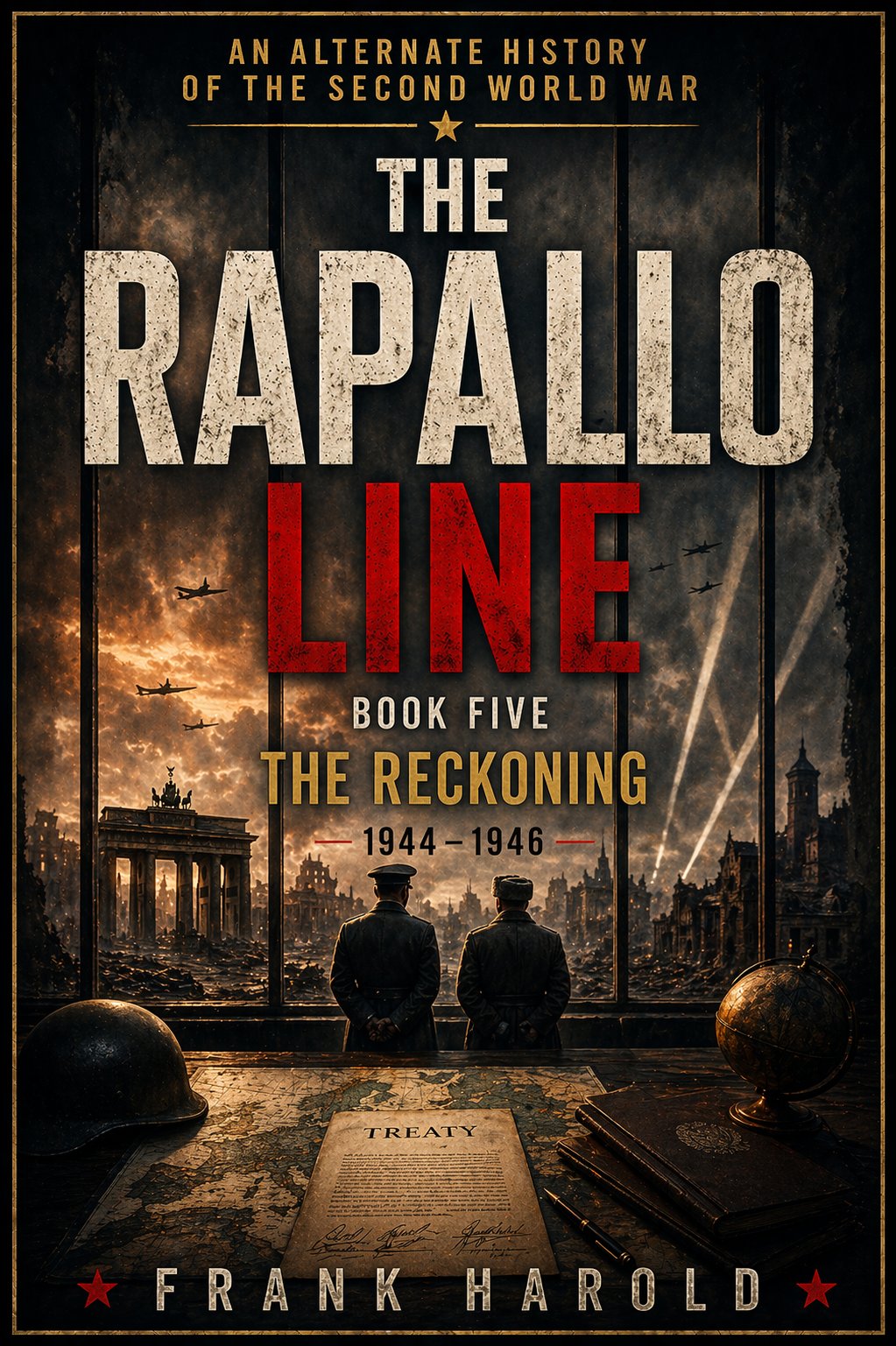
A taste of the opening
Read the first pages
The opening of the book — roughly 3,205 words — to let the voice do its own argument.
AUTHOR’S NOTE
The Rapallo Line is a work of alternate-historical fiction. It imagines a Second World War in which strategic, political, and operational choices diverged from the ones actually made, and follows the consequences through the lives of invented and historical figures alike. Events, dates, and outcomes depart deliberately from the record.
The Holocaust is referenced in this series. Its reality is not altered by the alternate timeline; the murder of Europe’s Jews and other targeted peoples is part of the historical ground on which any honest fiction of that war must stand. The author has tried to depict it with gravity and without exploitation.
Readers interested in the actual history of the period are urged to consult the standard works of scholarship. This series is an argument with that history, not a substitute for it.
A Historical Note
This novel continues and closes the alternate history of the Rapallo Line. The book opens in July 1944. The European war has been fought for nearly five years; the Pacific war for nearly a year. The Rapallo Pact — the covert German–Soviet military arrangement of 1922 which, in this telling, was not closed in 1933 — survives in diminished form. The Anglo-American counter-offensive has begun in the Mediterranean. The book covers the final eighteen months of the war and the diplomatic settlement that closed it without a victor. A fuller account of the real history against which the novel is set will be found in the Historical Appendix at the end of this book.
CHAPTER ONE
The Sixth Summer
Joint Intelligence Committee
JIC (44) 268 — The Position at Mid-Summer 1944
Top Secret.
11 July 1944.
1. The European war, in its fifth summer, remains an attritional stand-off on the Persian line, a sustained bomber offensive over the Reich, and a naval war in the Atlantic now resolved in Allied favor. No cross-Channel operation has been mounted or is, on present Staff appreciation, feasible in 1944.
2. Persia front. Eighth Army (British and Commonwealth), Fifth Army (US), and Ninth Army (US) hold the line Hamadan–Kermanshah–Ahvaz: thirty-two divisions (fourteen British and Imperial, twelve United States, four Indian, one Polish, one Free French), 640,000 men, 2,240 tanks (Sherman, Churchill, Valentine), 3,400 guns, 1,680 aircraft. Opposing: Heeresgruppe Süd (1., 4., and 6. Gebirgs-Armeen) and Heeresgruppe Kaukasus, 520,000 men, 1,280 tanks and assault guns, 1,120 aircraft. Ground casualties, January through June 1944: Allied, 18,400 killed, 41,200 wounded; German, on SIS estimate, 14,800 killed, 36,000 wounded, 3,100 prisoners.
3. Strategic bombing. Sorties despatched against Reich territory, January through June 1944: RAF Bomber Command, 38,420 (night); Eighth Air Force, 22,110 (day). Losses: 2,640 heavy bombers (of which 1,420 RAF, 1,220 USAAF), 3,110 fighters escort, 18,200 aircrew killed or missing. Bomb tonnage delivered: 318,000 long tons. German civilian casualties, same period, on SIS and Swedish estimates: 71,000 killed, 94,000 seriously injured. The Ruhr and Hamburg assessments indicate industrial plant reduction at the rate of one large works per week.
4. Atlantic. U-boat fleet strength, 1 July: 186 operational boats against a peak of 240 in August 1943. January–June sinkings: 68 merchant vessels (384,000 GRT); U-boat losses: 114. The exchange, running at better than three-to-two in the Allies’ favor through 1943, stands in the first half of 1944 at nearly two-to-one.
5. Pacific. American Sixth Army and Eighth Army hold the east-coast Luzon lodgement and the northern bridgehead at Lingayen: twelve divisions ashore, 280,000 men; opposing Japanese Fourteenth and Thirty-Fifth Armies, 220,000. United States Pacific Fleet at present strength: 18 fast battleships, 14 fleet and 22 light and escort carriers, 58 cruisers, 340 destroyers. Imperial Japanese Combined Fleet: 7 battleships, 5 fleet and 2 light carriers, 12 heavy cruisers, 104 destroyers. Combat casualties in the Philippines theater to 1 July: American, 28,400 killed, 71,000 wounded; Japanese, on best estimate, 62,000 killed.
6. The Reich’s staff officers, this Committee assesses, compile figures which correspond within a small margin to the figures at paragraphs 3 and 5. The political fact of the war, on the evidence of such figures, is that neither side can, in 1945 or 1946, find the means to force a decision by arms. That political fact is now known at Berchtesgaden, at Broadway, at the Map Room, and at Stavka. It is not yet known, or not yet admitted, at any of the three capitals whose political leaderships have staked their offices upon the war’s continuation.
— Cavendish-Bentinck.
———
London, Broadway Buildings, 14 July 1944
Ashworth’s office in Broadway had, since the move of the service’s Persian and Levantine desks to the fourth floor in the autumn of 1942, occupied the same small room at the east end of the corridor, with the same small window looking down into the courtyard of Saint Ermin’s. He was, on the fourteenth of July, fifty-one years old. He had been in the service, counting the three years at Constantinople before the Armistice and the four at Riga in the early twenties, for twenty-nine of those years. He had been at his present desk, running the Persian station from London, since the spring of 1942, when the Afrika–Persia front had opened and a man who had read Qajar court archives for pleasure in the twenties had become the obvious officer to hold the file.
The Afrika–Persia file on the fourteenth of July sat in its usual place on the left side of the desk, which had been, before the war, the place of his tray for outgoing messages and which, since the spring of 1942, had been the place of the file. It was, in the middle of July 1944, three green folders thick. The oldest of the three went back to the opening of the German southern front in May 1942. The newest was the running-week collation of Tehran and Baghdad station traffic, which his deputy, Latimer, prepared on a Sunday evening and which appeared on the desk on the Monday morning.
He took, at half past nine on the fourteenth, which was a Friday, the newest folder off the top of the stack. He opened it at the first page. The first page was, as it was every week, the routing list. The third entry on the routing list, below Baghdad station and the Tenth Army liaison officer, was *Volker, A., Assistant Naval Attaché, Tehran: six cables, week ending 9 July.*
He read the Volker cables through.
There were, as there had been through the preceding eleven months, six of them. They were, as they had been through the preceding eleven months, competent intelligence reports of the German southern armies’ order of battle along the Kermanshah and Hamadan sectors, drawn from sources which Volker identified, by the station cipher, as three local informants of long standing and two Polish deserters from the Reich’s Caucasus-bloc labor force. The cables were, by any professional measure, first-class material. They had, through the preceding eleven months, been passed on to the Middle East Intelligence Center at Cairo and to the Joint Intelligence Sub-Committee’s Persian rapporteur and to the Tenth Army’s G-2, and had formed, in that period, the backbone of the London picture of the German left flank in Persia.
Ashworth had known, since a morning in the middle of April of that year, that Volker’s three local informants did not exist, that Volker’s two Polish deserters were fabrications of a class he had himself, in his Riga years, helped to write, and that Volker’s cables from Tehran were, in their origin, the product of a long-standing Soviet staff officer in the Persian rear, who had been running Volker, through cutouts and through a mail-drop at the Tehran post office, since some date in the autumn of 1942, and possibly earlier.
He had known it on the authority of Brandt, who was in the converted country house at Buckinghamshire which the service used for such cases, and who, on the morning of the twelfth of April, in a session for which Ashworth had been present, had named, from his Berlin knowledge, the three local informants of Volker’s cables as names which had, in the Abwehr’s own Persian files of the summer of 1942, been recorded as Soviet-controlled. Brandt had added that the service of which Volker was in receipt was, on the Abwehr’s assessment, a service of what Brandt had called the *parallel channel,* by which the Rapallo Pact’s signatories exchanged, through deniable cutouts, intelligence which would otherwise have had to pass through the political offices of the Foreign Commissariat and the Foreign Ministry and would therefore have been reportable to the Anglo-American powers as a pact activity. The cables Volker sent, Brandt had said, were true in their military content. They were true because they were written by a Soviet staff officer who had access to the German order of battle opposite him, and who had decided, for reasons Brandt did not pretend to guess, to feed them to the British.
Ashworth had taken the Brandt session home that night in the memory that served him in place of a notebook. He had, through the remainder of the spring and the first half of the summer, done with the information what a career in the service had taught him to do, which was nothing. He had not, in the two months since, told the Chief. He had not told Menzies’s deputy. He had not told the Tenth Army. He had filed the April Brandt session, under the running file-number the service kept for the Brandt debrief, and he had watched the Volker cables continue to come in, and he had passed them on, as he had passed them on before, to Cairo and to the JIC.
He was not, at fifty-one, in doubt that the position he had taken was a professional position for which, if it came to be known, he could be called to account. He was in no doubt that it was also the position of a man who had decided, without making the decision explicit, that the Soviet staff officer in the Persian rear knew what he was doing, and that the British order-of-battle picture of the German left flank was the better, in the summer of 1944, for the Soviet staff officer’s having continued to run it. He was also in no doubt that the position was the position of a man who had, for reasons he had not, on any walk to or from the Tube, examined, declined to end the career of a naval attaché of thirty-seven whose cables he had been reading, by then, for three and a quarter years.
He closed the folder. He put it back on the left side of the desk, under the two older folders. He took, from the drawer, the minute paper on which he wrote the weekly covering note for the JIC’s Persian rapporteur. He wrote the note in the small precise hand he had used for twenty-nine years, noting that the week’s Tehran traffic confirmed the Kermanshah sector as in the condition of positional stand-off which had held since April, and that the Hamadan sector showed the usual summer thinning of the German second-echelon formations as they were rotated for rest behind the line. He signed the note. He put it in the tray for the clerk to take up at eleven.
He stood, for a moment, at the window. The courtyard at Saint Ermin’s, at a quarter to eleven on a Friday morning in the middle of July, was empty except for the porter, who was sweeping the paving under the north arch in the unhurried manner of a porter who had been at his post since 1919 and had swept the same paving through two wars. Ashworth watched the porter for some moments. He thought, as he stood at the window, of Armitage, who had been his closest friend in the service, and who had been killed in Lisbon on the fourteenth of March 1943, by the operation which he, Ashworth, had that winter helped to run. Armitage, on that question, had made the other decision.
He turned from the window. He sat down again at the desk. He took the next folder, which was the Middle East economic warfare paper for the week, and he opened it at the first page.
❖
Washington, White House Map Room, 28 July 1944
The Map Room was in the ground-floor corridor of the East Wing, in the room that had been, before the war, a ladies’ cloakroom, and that had been fitted out, in the first week of January 1942, with the three large wall maps, the cipher safes, and the twenty-four-hour officer-of-the-watch desk which Admiral Leahy had ordered. Cadwallader, on the evening of the twenty-eighth of July, was the officer of the watch from six to midnight. He was twenty-nine years old. He had been a Princeton undergraduate in the spring of 1938, a junior historian at Yale in the year before Pearl Harbor, and, since the March of 1942, one of the rotating officers of the Map Room. He wore the uniform of a Lieutenant, United States Naval Reserve, with two stripes on the sleeve and the shoulder cord of a White House duty officer.
At seven o’clock on the twenty-eighth the Pacific desk was manned by Ensign Lorimer, who had reported to the Map Room on the tenth of July, and who was the replacement for Ensign Preston, who had, on the twenty-ninth of June, been transferred to the Pacific Fleet at his own request. Lorimer was twenty-three years old. He had been, until April, a graduate student at the University of Michigan. He was at that hour bent over the Luzon map at the east wall, moving the red-headed pins of the Japanese Fourteenth Army’s positions by a quarter of an inch to the south, on the authority of a signal which had come in at a quarter past six from Nimitz’s intelligence officer at Pearl.
The Luzon map, at seven o’clock on the twenty-eighth of July, showed the American line as it had stood since the fifteenth of the month: a shallow arc running from the west coast north of Subic Bay across the central plain to the eastern foothills above Cabanatuan, with the American Sixth Army in position along its length. Behind the line the map showed the lodgement area, the four airfields the Americans had built in the spring, and the port works at Lingayen. Ahead of the line, to the north, the map showed the Japanese positions in the Caraballo Mountains, pinned in the red which Map Room convention reserved for the forces of the Empire of Japan.
Cadwallader sat at the officer-of-the-watch desk in the middle of the room. He had on the desk the daily folder, which had come down from the President’s study at six, and which contained the single-sheet summaries of the day’s operations in the four theaters in which the United States was, in the summer of 1944, at war. He had already, in the first hour of his watch, initialled the Persian summary (positional), the European air summary (fifteen hundred sorties, forty-one aircraft lost), and the North Atlantic summary (no contacts). He was at the Luzon summary when Lorimer came back from the wall.
“Sir. Pearl moved the pins on the Fourteenth Army’s Ninth Division.”
“South a quarter inch.”
“South a quarter inch, sir.”
“The signal is on my desk?”
“It is, sir.”
Cadwallader read the signal. It was, as most of the Pacific signals were, a brief administrative statement of a patrol-action result by the Sixth Army’s intelligence section: a Japanese rifle company had, on the afternoon of the twenty-sixth, pulled back three hundred yards at a point in the Ninth Division’s front, and had not, on the twenty-seventh, reoccupied the forward position. On the Luzon map it was, as the quarter inch suggested, a movement of the smallest unit of observable event.
He initialled the signal. He noted the entry in the watch log. He said, to Lorimer, who had returned to the east wall and was standing, for a moment, looking at the map in the posture of a young officer who was still, in his third week, learning to read it, “Ensign Lorimer.”
“Sir.”
“You have been here now three weeks.”
“Three weeks on Sunday, sir.”
“When you look at the Luzon map, what do you see.”
Lorimer looked, for a moment, at the map, and then back to Cadwallader. He was a serious young man who had reported to the Map Room with a careful list of questions he had prepared on the flight from Detroit, and who had, in the three weeks since, not yet lost the habit of answering a senior officer’s question at the length the question seemed to warrant.
“I see,” he said, “an American army in a lodgement on a Philippine island, holding a line which it has held since June, facing a Japanese army which is, on the Pearl estimates, at a strength of perhaps four-fifths of the American army, and which has not, since May, attacked.”
“And?”
“And I see that the two armies, on the present rate of movement, will be in those positions for the rest of the summer, and possibly through the autumn.”
“And the war.”
Lorimer hesitated. “Sir, I would rather not, on this map, give an opinion on the war.”
“That is correct, Ensign. You would rather not.”
Cadwallader let the exchange close. He was, at twenty-nine, old enough to remember, from his first summer in the Map Room in the spring of 1942, the man who had been the officer of the watch on his first training shift, who had been a Lieutenant Commander named Turnbull, and who had, on the afternoon of Cadwallader’s second day, put to him a question of the same kind. Turnbull had, in the two years since, rotated back to the fleet and had been lost in the Coral Sea action of October 1943. Cadwallader had not, until that moment on the evening of the twenty-eighth, thought of him in a month.
At eleven he wrote the midnight summary. He wrote it, as he had written every midnight summary for two years, in the small precise hand he had brought with him from Princeton. He wrote, on the Persian line, *positional; no movement reported in the 72 hours ended this date.* He wrote, on the European air line, *combined bomber offensive: 1,500 sorties, 41 aircraft lost. Principal targets: Leuna, Poelitz, Ruhr.* He wrote, on the North Atlantic line, *no contacts.* He wrote, on the Luzon line, *Fourteenth Army (Japanese) Ninth Division withdrew one rifle company 300 yards south, sector of Sixth Army XIV Corps; no reoccupation of forward position noted at close of the 27th.*
He did not write the sentence which, on his private notebook, a small green-bound book which he kept in the inner pocket of his uniform jacket and which no officer of the Map Room had ever seen, he wrote at eleven-fifteen: *The President is at Hyde Park this weekend. We have been, on this date, eleven months at war. The Pacific moves by quarter inches and the Philippines desk has a new clerk and none of us, in any corridor I frequent, believes this will end inside a year.*
End of sample
Continue reading
The full 64,289-word book is available on Amazon as a Kindle ebook.
Available on Amazon →